
Author: dmaxey
CantonRep: Minerva Forms Community Band
The Canton Repository has posted a story about the formation of our community band on their website.
MINERVA — Dust off those drums; shine up that saxophone; and trumpet the virtues of that long-forgotten trombone.
Minerva has started a community band!A group that has grown to 50 members began practicing last month. In the coming months, they’ll begin practicing for their first-ever performance — a Memorial Day concert.
As part of a college master’s project, High School Band Director Derrick Maxey became curious why so many high school students stop playing their instruments after they graduate.
What he found was that many had the impression they had to be a virtuoso to play beyond high school.
That’s simply not true.
So, Maxey set out to create a community band.
It’s open to all ages and all skill levels.
By the way, he’s always looking for new members. He can be reached at the school at 330-868-4134.
Minerva Student Builds Bass Guitar

Using a piece of aged pine he found in his garage, Minerva senior band member Conor Freeland used a band saw to build his own custom electric bass guitar. He then painted the body with green and blue wood stain. The neck and other electrical parts he bought online and installed himself. The bass is about an inch longer than a standard electric bass.
You can hear Conor, his custom bass, and the rest of the Minerva High School Jazz Band in action at Friday home varsity basketball games beginning Friday, December 4th.
New Piano Donated By John Admonius
 A new Wurlitzer upright piano was donated to the MHS band program by John Admonius. The piano will be used by the Symphonic and Jazz Bands as well as to accompany students as they are preparing for Solo and Ensemble.
Studying Music Improves Your Hearing
Recent research suggests that music training increases an individual’s ability to perceive and distinguish sound.
Musical training can improve your hearing, according to several studies presented in Chicago at Neuroscience 2009, the annual meeting of the Society for Neuroscience.
The studies found that serious musicians are better than other people at perceiving and remembering sounds. But it’s not because they have better ears.
Sounds come in through the ears. But they travel through the nervous system and get interpreted by the brain.
That means your hearing can change even if your ears don’t, says Nina Kraus, who directs the Auditory Neuroscience Laboratory at Northwestern University.
L-I-O-N!
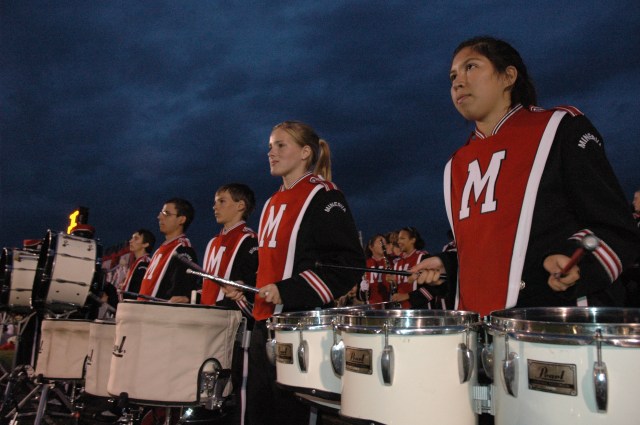
Homecoming 2009

Minerva Community Band Night
Monday, November 2nd from 6 to 7pm in the Minerva High School band room will be a night for Minerva community members to get together and play their band instruments. It’s open to all ages and ability levels, even current students are invited to attend.

Pics Of Friday Night’s Show Available Online
Pictures from each week’s half-time shows are available on FridayNightOhio.com.
 The Pride Of Minerva